You can share
- Share to Facebook
- Share to Google+
- Subscribe to our
- Share to Linkedin
- Share to Twitter
You can share

Custom lanyards represent one of the most cost-effective and functionally essential assets in corporate event management, conference credentialing, and workplace security. According to industry research from the Advertising Specialty Institute (ASI) and the Promotional Products Association International (PPAI), event badges and branded neckwear achieve over 90% on-site visibility during conferences and trade shows, while delivering sustained utility across corporate campuses, healthcare facilities, and government institutions.
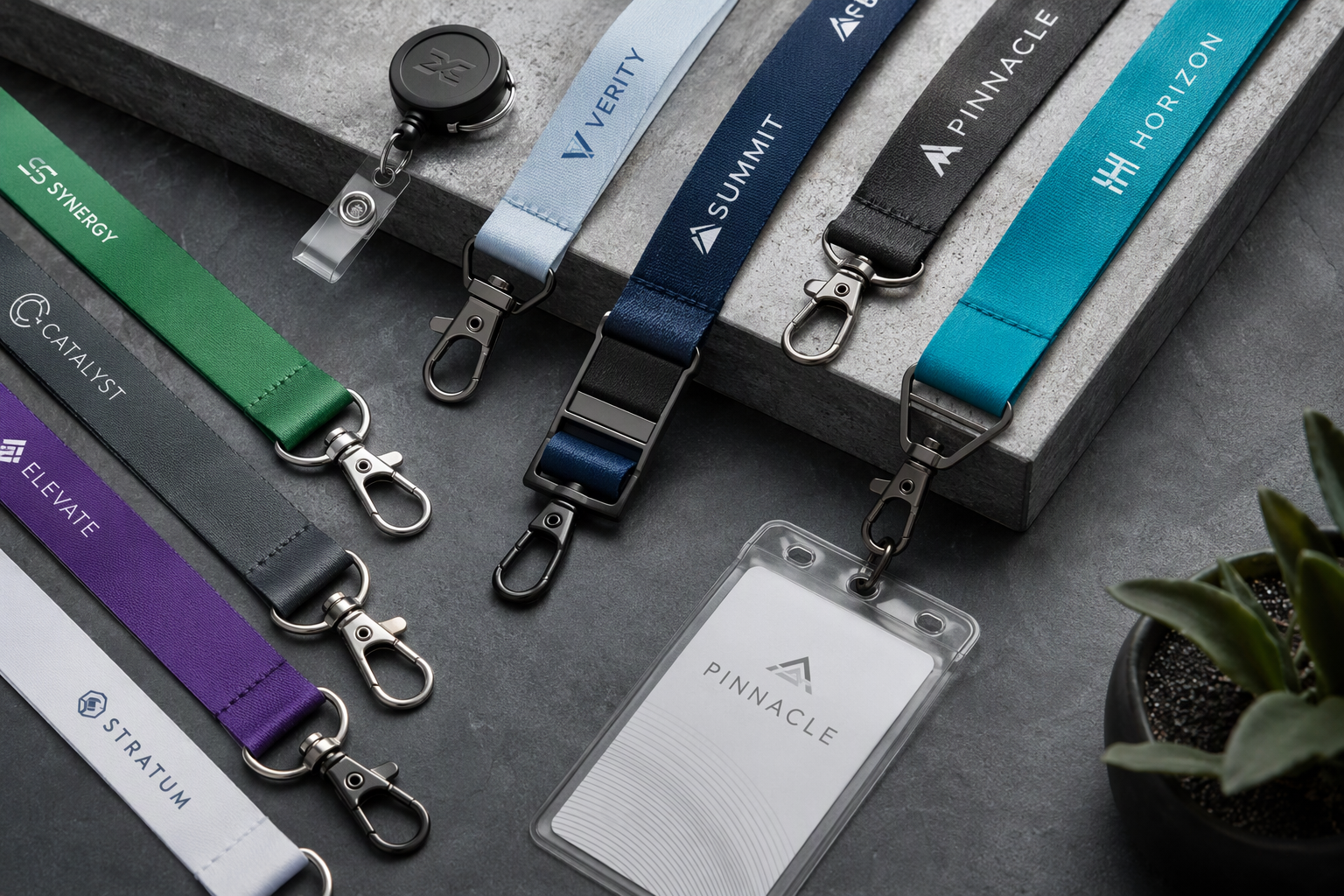
Far from being a generic giveaway, a precision-engineered custom lanyard combines textile durability, high-definition brand reproduction, and critical mechanical safety features. Selecting the right strap material—whether ribbed flat polyester, ultra-smooth dye-sublimated satin, or eco-friendly recycled rPET—paired with durable zinc alloy hardware and quick-release breakaway mechanisms ensures that corporate credentials remain secure, comfortable, and visually authoritative. This comprehensive B2B procurement guide examines the technical mechanics of lanyard construction, compares core weaving and printing methods, details essential safety compliance standards, and provides an actionable quality assurance framework for global sourcing managers.
In high-density conference environments, trade exhibitions, and enterprise office complexes, custom lanyards serve a vital dual function: high-frequency visual brand impression and instantaneous credential verification. A poorly manufactured lanyard—prone to twisting, fraying, color fading, or skin irritation—negatively impacts brand perception and risks badge loss. Conversely, a well-balanced, high-density woven or sublimated lanyard elevates executive badges, VIP passes, and employee access cards into polished brand touchpoints.
Global event organizers and procurement teams must evaluate lanyards across four primary technical pillars:
Material Weave & Tactile Comfort: Ensuring all-day wearable comfort against neck skin without chafing or fiber degradation.
Graphic Reproduction & Colorfastness: Achieving Pantone-matched corporate color accuracy that resists friction, sweat, and UV exposure.
Hardware Load Capacity & Plating: Utilizing die-cast zinc alloy or steel swivel clasps that withstand dynamic movement without accidental unlatching.
Occupational Safety Compliance: Incorporating auto-release breakaway clasps that eliminate snag and entanglement hazards in accordance with workplace safety norms.
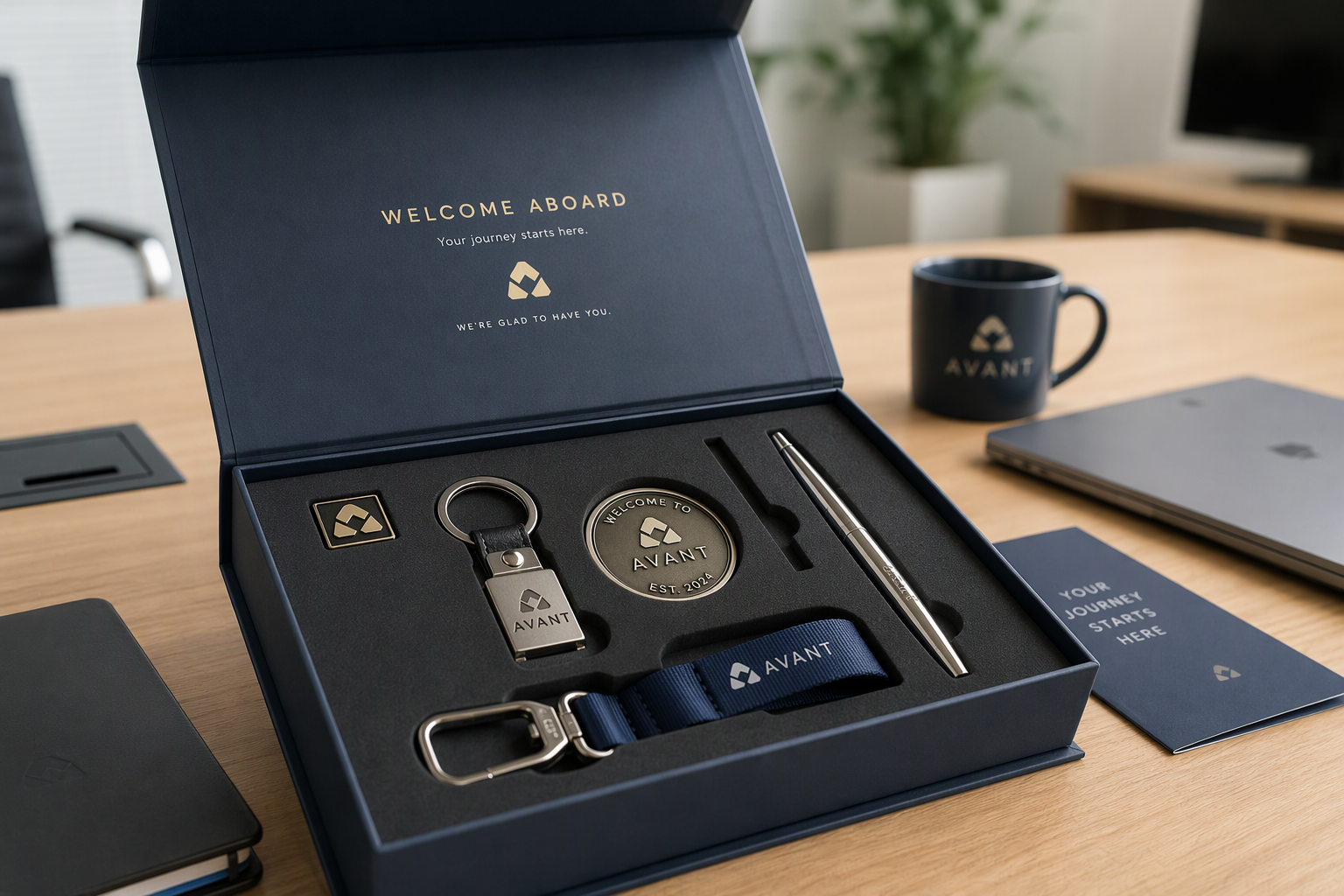
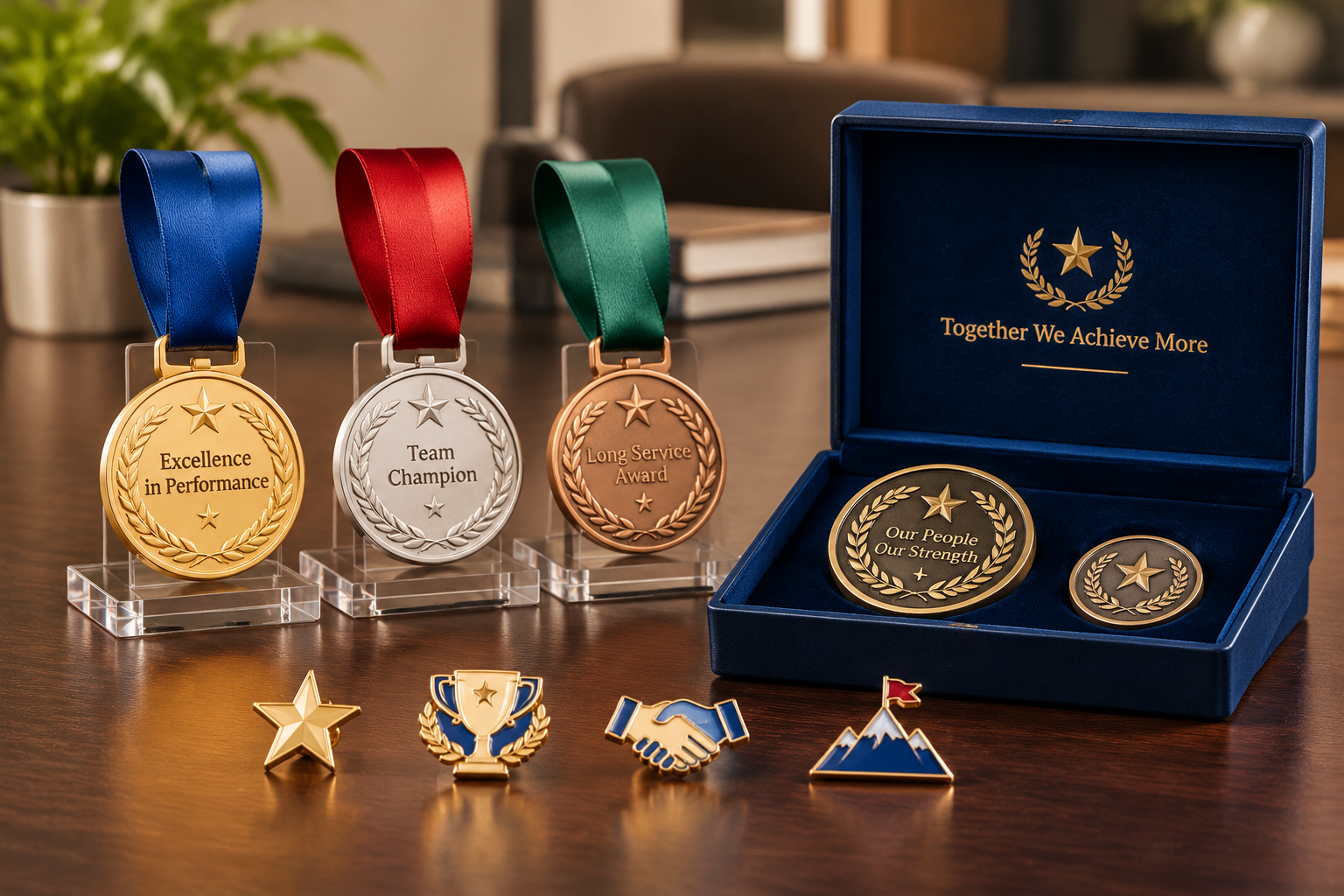
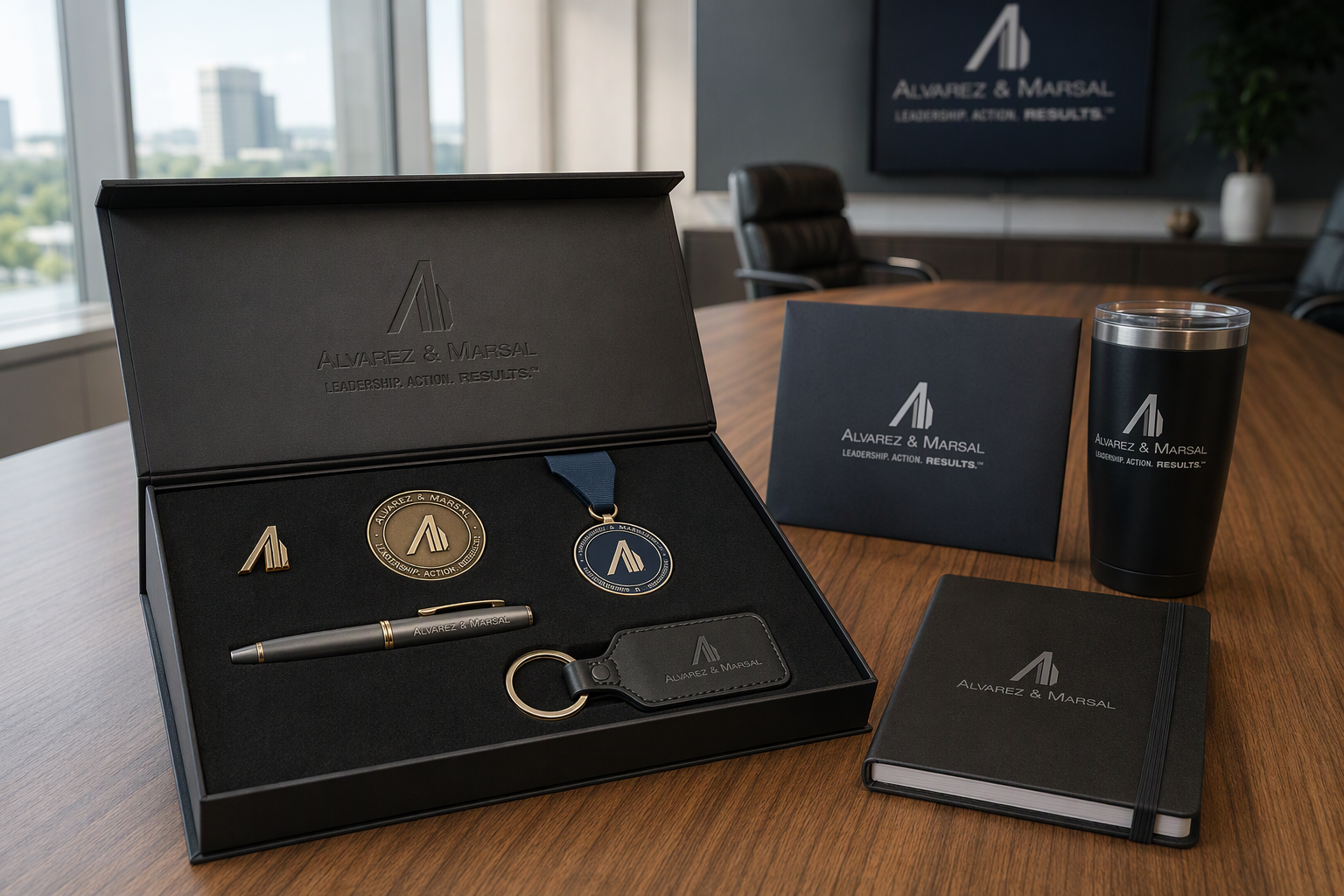
At Artigifts, where custom metal craftsmanship meets integrated promotional manufacturing, custom lanyards are engineered as complete badge systems—frequently combined with custom metal lapel pins, commemorative event medals, and heavy-duty zinc alloy badge clips to deliver cohesive corporate branding.
The core substrate of any lanyard governs its structural memory, tensile strength, drape, and graphic suitability. Global procurement teams typically select between five primary material categories:
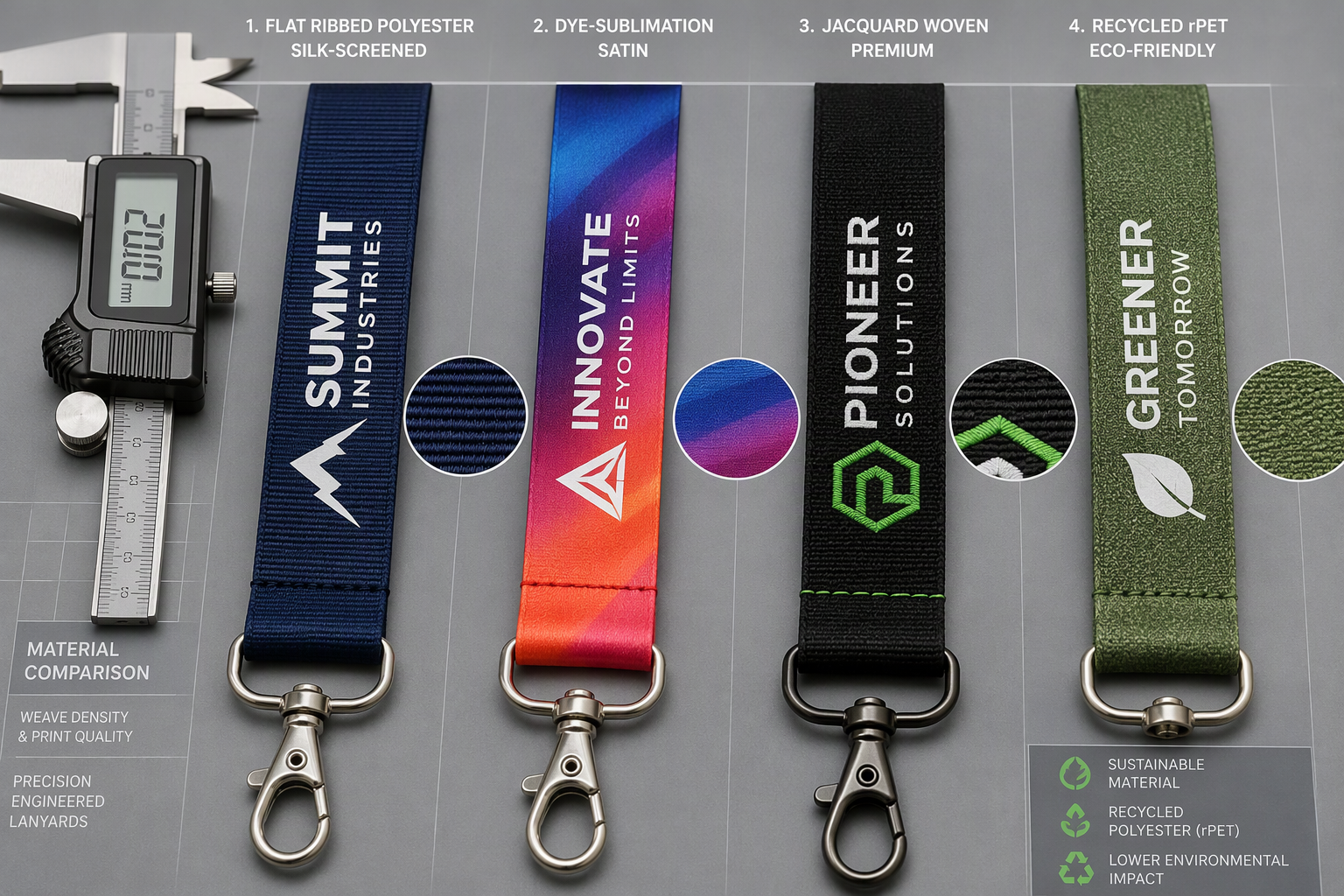
Flat polyester is the most widely deployed material in B2B corporate events due to its exceptional dimensional stability, high tensile strength, and budget efficiency. The textured ribbed surface provides excellent ink adhesion for precision silk-screen printing of bold logos, typography, and single-to-triple color corporate identities.
For events featuring complex gradient logos, photographic backgrounds, or multi-tiered corporate sponsorship matrices, dye-sublimation (heat-transfer) lanyards are the premier choice. The sublimation process gasifies disperse dyes directly into the polyester filament pores at 200°C+, creating a continuous, seamless graphic layer that will never crack, peel, or scratch off during multi-day conferences.
As multinational corporations enforce strict Scope 3 ESG (Environmental, Social, and Governance) targets, recycled polyethylene terephthalate (rPET) lanyards made from post-consumer recycled plastic bottles have become a staple. rPET lanyards offer identical tensile performance and print clarity to virgin polyester while carrying verifiable Global Recycled Standard (GRS) and OEKO-TEX Standard 100 environmental credentials.
| Material Type | Weave Structure | Tactile Feel | Branding Compatibility | Best B2B Application | Durability |
|---|---|---|---|---|---|
| Flat Ribbed Polyester | Tight cross-weave ribbed polyester | Structured, firm, textured | Silk-screen printing (1–4 solid colors) | High-volume trade shows, general staff ID | ★★★★½ (4.5 / 5.0) |
| Dye-Sublimated Satin (rPET / Poly) | Ultra-dense smooth filament micro-weave | Silky, ultra-soft, cool touch | Full-color CMYK heat transfer gradients | High-end tech summits, VIP passes, multi-sponsor events | ★★★★★ (4.8 / 5.0) |
| Nylon Webbing | Heavy-duty lustrous flat weave | Thick, glossy, premium weight | Silk-screen & raised silicone print | Industrial facilities, security personnel, high-durability ID | ★★★★★ (5.0 / 5.0) |
| Tubular Polyester | Hollow circular knit tube | Soft, padded, lightweight | Silk-screen spot printing | Budget-conscious academic conferences, sports events | ★★★½☆ (3.8 / 5.0) |
| Woven Jacquard | Interlocking dyed yarn embroidery | Heavy, textured, dual-tone | In-weave thread pattern (no ink overlay) | Government agencies, military heritage, executive summits | ★★★★★ (5.0 / 5.0) |
The functional reliability of a custom lanyard depends entirely on its terminating hardware. A snapped clip or jammed swivel hook leads to lost event passes and security bottlenecks. Professional event suppliers utilize precision die-cast zinc alloy and stainless steel components engineered for thousands of open-close cycles.
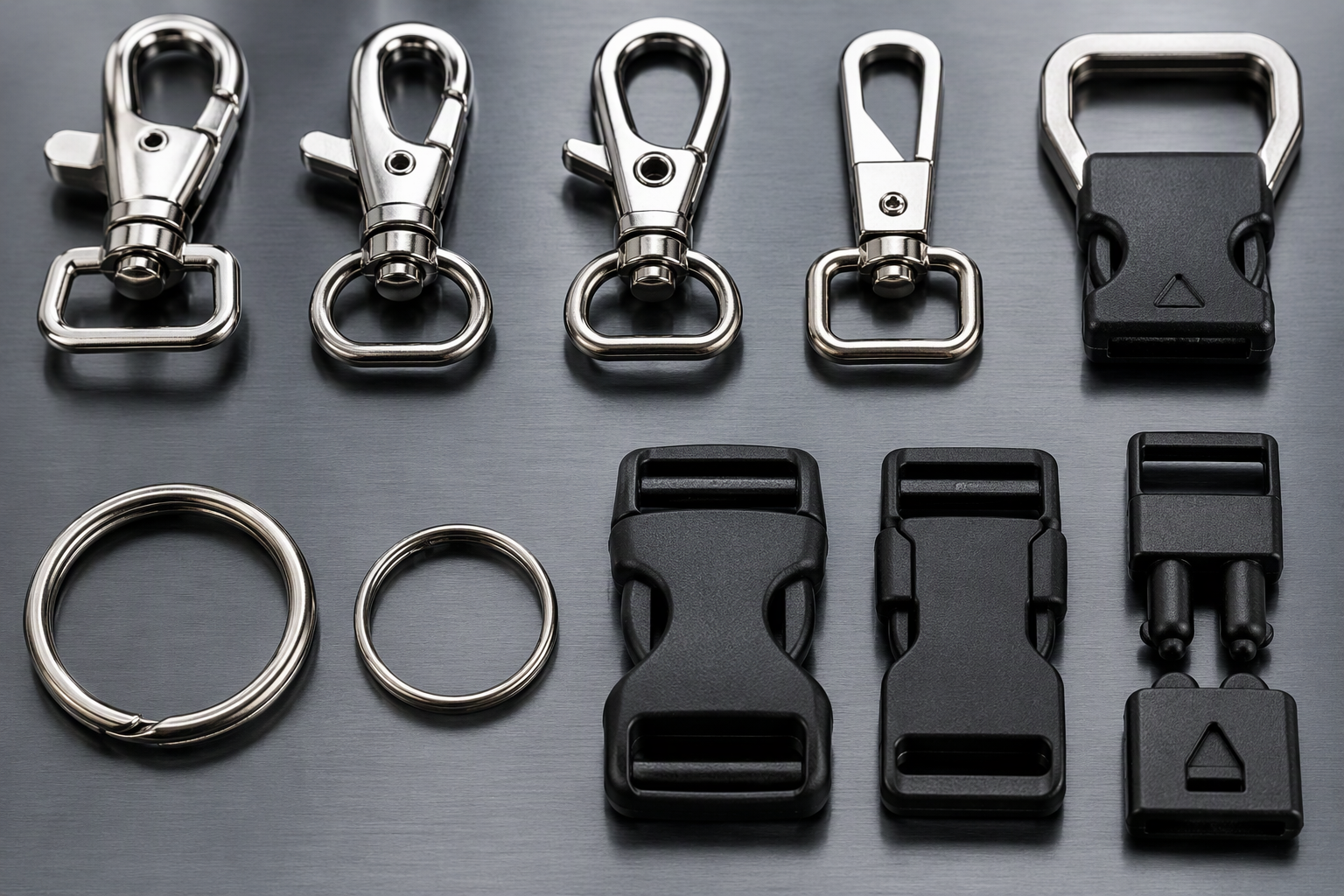
Die-Cast Zinc Alloy Lobster Claw Clasp: Premium jewelry-grade trigger snap with a 360-degree ball-bearing swivel head, preventing badge twisting and offering effortless one-handed attachment.
Nickel-Plated Metal Swivel J-Hook: Heavy-duty spring wire hook engineered for quick attachment to punched plastic badge holders and multi-slot conference pouches.
Flat Metal Key Ring with Eyelet Rivet: Traditional split-ring configuration for dual-purpose key retention and security credential attachment.
Detachable Plastic Quick-Release Buckle: Heavy-duty POM (polyoxymethylene) buckle located 5–10 cm above the clip, allowing wearers to detach their key or badge without removing the neck lanyard.
Heavy-Duty Zinc Alloy Retractable Badge Reel: Integrated cord reel providing 60–80 cm of reach for seamless electronic RFID card swiping at security turnstiles.
In healthcare facilities, schools, manufacturing plants, and active trade show exhibition halls, neckwear presents a potential mechanical snag hazard. Workplace safety bodies, including OSHA (Occupational Safety and Health Administration) and ANSI/ISEA guidelines, recommend or mandate safety breakaway mechanisms for workplace neck accessories.
A safety breakaway is a molded plastic or magnetic connector installed at the nape of the neck. When subjected to sudden tensile stress exceeding a calibrated threshold (typically 15–25 N / 1.5–2.5 kg of sudden pulling force), the clasp instantly separates, releasing the lanyard from the wearer’s neck and preventing choking or mechanical entanglement.
Before authorizing mass production of custom lanyards for international corporate conferences or enterprise distribution, sourcing professionals should demand pre-production physical proofs and enforce the following quality verification protocol:
Dimensional Accuracy & Alignment: Standard adult lanyard length is 900 mm (450 mm folded length) with standard widths of 15 mm, 20 mm, or 25 mm. Graphic elements must remain centered without rotational skew along the entire length.
Seam Construction & Stitching: Critical stress points—particularly where the strap loops around metal clasps or safety clips—must be reinforced with heavy-duty box stitching or ultrasound thermal welding.
Plating Durability: Zinc alloy and metal components must exhibit uniform electroplating (shiny nickel, antique brass, matte gunmetal, or gold) capable of passing standardized ASTM B117 salt spray tests without surface oxidation or flaking.
Chemical Compliance & Skin Safety: Ensure all dyed textiles and plastic components meet OEKO-TEX Standard 100, EU REACH Annex XVII, and US CPSIA limits for restricted heavy metals and phthalates.
Standard B2B production for custom lanyards typically requires 7–12 business days following pre-production digital proof approval, with express sample lead times of 3–5 days. For large-scale conference orders (10,000+ units), allow 2–3 weeks for specialized dye-sublimation and hardware assembly.
20 mm (3/4 inch) is the global corporate standard, providing the ideal balance of wearable comfort and ample surface area for readable corporate logos and URLs. For minimalist ID badging, 15 mm (5/8 inch) is common; for multi-sponsor sporting events or high-impact graphics, 25 mm (1 inch) offers maximum visual footprint.
Polyester lanyards feature a matte, ribbed texture with high tensile strength and budget efficiency. Nylon lanyards have a tighter, heavier weave with a natural lustrous sheen and slightly thicker drape, making them ideal for high-end executive gifts or industrial security badging.
While not universally mandated for standard seated conferences, safety breakaway clips are strongly recommended for all public events and required in healthcare, educational, manufacturing, and airport environments to mitigate choking and entanglement risks.
Yes. Recycled rPET lanyards, manufactured from post-consumer recycled plastic bottles, offer identical durability, soft hand-feel, and vibrant full-color sublimation print capabilities while meeting corporate sustainability and ESG purchasing criteria.
Standard finishes include polished nickel, shiny chrome, matte black electrophoresis, antique brass, antique bronze, and rose gold. Specialty die-cast zinc alloy clasps can also be custom-molded with debossed or engraved company logos.
Lanyards are bundled in individual protective polybags or organized in flat-packed sets of 10–50 units with protective paper collars to prevent strap entanglement and hardware scratching during shipping and rapid on-site registration desk distribution.
Promotional Products Association International (PPAI): Product Power Research & Responsibility Guidelines for Event Merchandise — https://www.ppai.org/media/responsibility/
Advertising Specialty Institute (ASI): Global Ad Impressions Study on Promotional Apparel and Event Accessories — https://www.asicentral.com/news/research/
Occupational Safety and Health Administration (OSHA): Personal Protective Equipment and Workplace Safety Standards for Neckwear and Lanyards — https://www.osha.gov/laws-regs/regulations/standardnumber/1910
OEKO-TEX Association: Standard 100 Certification Criteria for Skin-Contact Promotional Textiles — https://www.oeko-tex.com/en/our-standards/standard-100-by-oeko-tex
ASTM International: ASTM B117 Standard Practice for Operating Salt Spray (Fog) Apparatus for Plated Metal Hardware — https://www.astm.org/b0117-19.html