You can share
- Share to Facebook
- Share to Google+
- Subscribe to our
- Share to Linkedin
- Share to Twitter
You can share

B2B buyers sourcing sustainable promotional merchandise must distinguish between third-party certified ecolabels, manufacturer self-declarations, and vague marketing claims to avoid severe regulatory penalties and brand reputational damage. With the tightening of the Federal Trade Commission (FTC) Green Guides in the United States and the enforcement of the European Union Green Claims Directive, generic buzzwords such as “eco-friendly,” “green,” or “100% sustainable” without verifiable testing data are no longer legally compliant or commercially acceptable.
Procurement teams, marketing agencies, and corporate gift managers must implement a structured verification framework based on the ISO 14020 series (Type I, Type II, and Type III environmental claims). By demanding documented chain-of-custody certificates (such as GRS for recycled plastics/textiles and FSC for paper packaging), mill test certificates for recycled metal alloys (like recycled zinc alloy and brass), and comprehensive third-party lab reports (RoHS, REACH, and California Proposition 65), organizations can confidently build responsible gifting programs that withstand regulatory scrutiny and resonate with eco-conscious recipients.
In recent years, corporate sustainability has evolved from a discretionary public relations talking point into a core corporate governance requirement. Large enterprises, multinational organizations, and public institutions are now mandated by Scope 3 greenhouse gas reporting standards and corporate Environmental, Social, and Governance (ESG) frameworks to audit every tier of their supply chains—including promotional products, branded merchandise, employee recognition awards, and event giveaways.
According to industry data from the Promotional Products Association International (PPAI), corporate demand for sustainable promotional products has surged by over 60% since 2023. However, this surging demand has also led to widespread “greenwashing”—the practice of making misleading, exaggerated, or unsubstantiated environmental claims.
When a corporation distributes 10,000 branded items bearing unverified “biodegradable” or “recycled” claims at a major international trade show, the legal and brand liability falls squarely on the buying brand, not just the promotional vendor. Regulators and consumer protection agencies across North America and Europe have levied substantial fines against organizations failing to provide substantiating lifecycle and material data for promotional items.
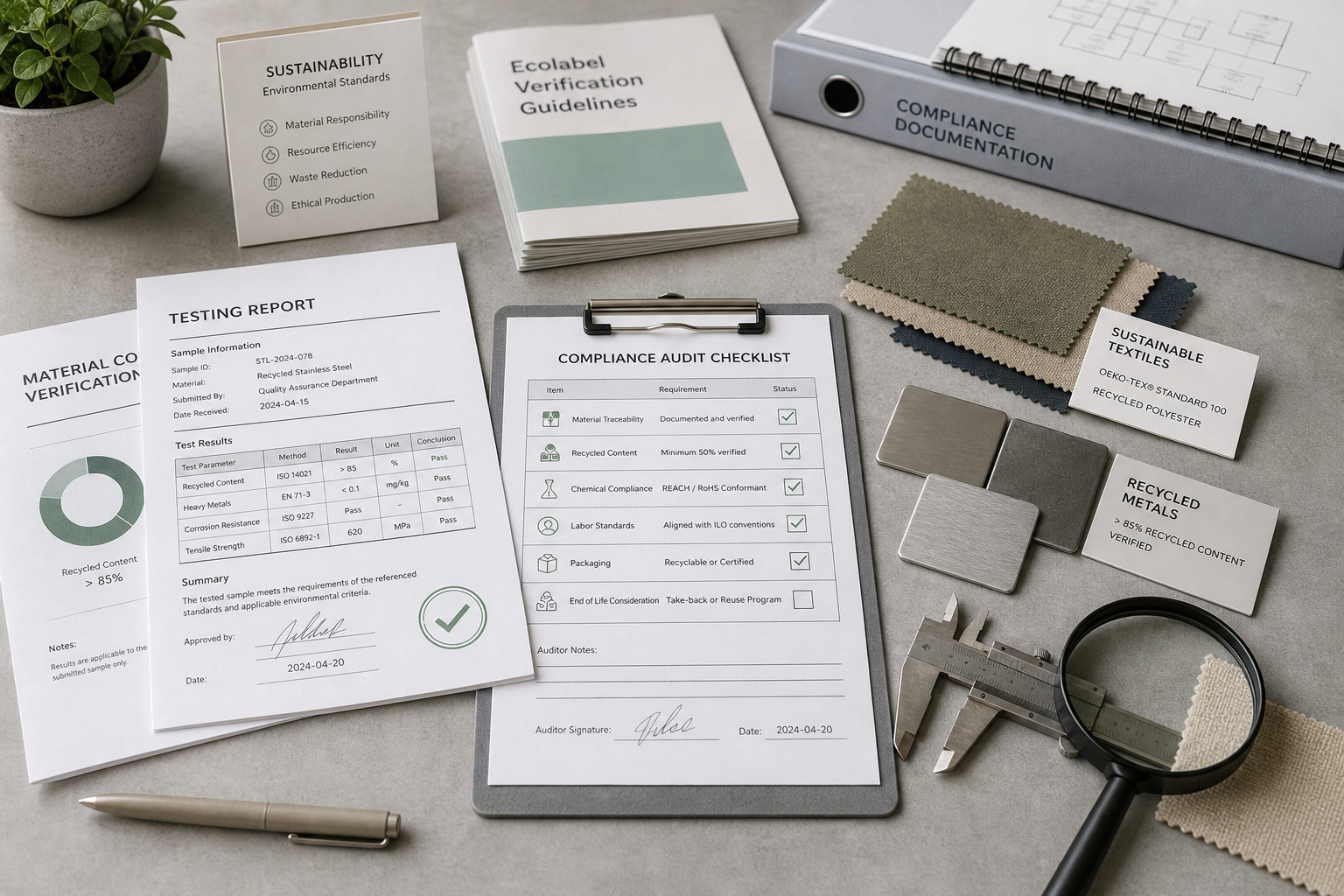
To effectively evaluate supplier claims, B2B procurement professionals must understand the global benchmark established by the International Organization for Standardization (ISO). The ISO 14020 family classifies environmental claims and ecolabels into three distinct tiers:
Definition: Type I labels are awarded by independent, accredited third-party organizations based on comprehensive lifecycle assessments (LCA). They evaluate environmental impacts from raw material extraction through manufacturing, packaging, use, and end-of-life disposal.
Examples: EU Ecolabel, Nordic Swan, Blue Angel (Blauer Engel), Cradle to Cradle Certified®.
Procurement Value: Highest credibility. Provides definitive proof of overall environmental excellence across multiple attributes.
Verification Method: Request the supplier’s valid certificate registration number and verify it directly against the official issuing registry.
Definition: Type II claims are first-party statements made directly by manufacturers, importers, or distributors regarding a single environmental characteristic (e.g., “Contains 40% Recycled Zinc Alloy,” “Recyclable Packaging,” or “Lead-Free Plating”).
Examples: Mobius loop with explicit percentage notation, “Compostable,” “Reusable.”
Procurement Value: Highly useful for specific components, but requires rigorous supporting evidence. Under ISO 14021, suppliers must maintain accessible verification data, test methods, and mathematical calculations.
Verification Method: Never accept a standalone claim or generic logo. Demand the specific third-party material test report (e.g., SGS, Intertek, or TÜV lab test) and bill of materials (BOM).
Definition: Type III declarations provide comprehensive, quantified lifecycle environmental data independently verified according to Product Category Rules (PCR). Unlike Type I labels, an EPD does not certify that a product meets a specific threshold; instead, it discloses the exact environmental footprint (such as carbon footprint, water use, and acidification).
Examples: Verified EPD documents published through platforms like the International EPD® System.
Procurement Value: Essential for enterprise buyers calculating precise Scope 3 carbon accounting for large-scale corporate merchandise programs.
When sourcing custom promotional items, corporate recognition gifts, medals, lapel pins, and packaging, procurement teams encounter diverse industry standards. The table below outlines key certifications, target materials, and essential verification checkpoints:
| Certification / Standard | Focus Category / Material | Claim Type | Verification Document Required | Buyer Verification Priority |
|---|---|---|---|---|
| Global Recycled Standard (GRS) | Recycled plastics, polyester lanyards, recycled fabric | Third-Party Chain of Custody | Transaction Certificate (TC) & Scope Certificate (SC) | Critical (prevents virgin material substitution) |
| FSC (Forest Stewardship Council) | Kraft paper boxes, cardboard packaging, wooden awards | Third-Party Forestry Chain of Custody | FSC License Code & Chain of Custody (CoC) invoice claim | Critical (verifies responsibly managed forests) |
| OEKO-TEX® Standard 100 | Neck ribbons, embroidered patches, lanyards | Harmful Substance Safety | Valid OEKO-TEX certificate number & lab test report | High (ensures zero harmful chemicals on skin contact) |
| Recycled Metal Mill Certificate | Recycled zinc alloy, brass, stainless steel, aluminum | Material Composition / Origin | Metallurgical Spectrometry Report & Ingot Invoices | High (confirms recycled content ratio & metal purity) |
| RoHS (2011/65/EU & 2015/863) | Metal plating, enamels, electronic promotional items | Heavy Metal & Hazardous Substance Restriction | Comprehensive XRF / ICP-OES Lab Test Report (SGS/TÜV) | Mandatory (Lead < 0.1%, Cadmium < 0.01%, Mercury < 0.1%) |
| REACH (EC 1907/2006) | Chemical substances, synthetic resins, soft PVC, coatings | SVHC Compliance | Full SVHC Screening Report (updated candidate list) | Mandatory (Nickel release, Phthalates, Organotins) |
| California Proposition 65 | Lapel pins, medals, keychains, drinkware, packaging | Safe Drinking Water & Toxic Enforcement | Lead (<100 ppm substrate, <90 ppm coating) Lab Tests | Mandatory (US distribution compliance) |
Global trade and environmental compliance authorities have established strict legal consequences for unverified claims:
The Federal Trade Commission enforces clear guidelines regarding deceptive environmental marketing:
Broad, Unqualified Claims Prohibited: Claims such as “eco-safe,” “green,” or “environmentally friendly” are deemed deceptive unless the marketer can substantiate all express and implied claims across the product’s entire lifecycle.
Recycled Content Requirements: A product or packaging cannot claim “recycled content” unless it explicitly states the exact percentage of post-consumer or pre-consumer recycled material.
Degradability Standards: An item cannot be marketed as “degradable” or “biodegradable” if it will end up in a standard municipal landfill where items do not decompose within one year.
The European Parliament and Council have enacted sweeping directives to eliminate commercial greenwashing:
Ban on Generic Environmental Claims: Banning claims such as “climate neutral,” “eco,” or “biodegradable” without certified, publicly accessible evidence.
Mandatory Pre-Verification: Environmental claims must be substantiated by accredited independent certifiers prior to marketing.
Carbon Neutrality Claims Restricted: Brands cannot claim a product is “carbon neutral” solely based on purchasing unverified carbon offsets.
Before signing a purchase order for custom promotional merchandise or branded corporate gifts, procurement managers should execute this 6-point due diligence checklist:
Demand Specificity Over Adjectives: Replace inquiries about “green options” with specific technical requirements: “Provide products containing certified post-consumer recycled (PCR) zinc alloy with ISO 14021 documentation.”
Verify Certificate Authenticity Online: Never accept screenshot copies of certificates without a certificate ID. Cross-reference FSC codes on info.fsc.org, OEKO-TEX IDs on oeko-tex.com, and GRS records on Textile Exchange.
Inspect the Physical Scope of the Claim: Clarify whether the ecolabel applies to the entire product, a single component, or merely the outer packaging. Misrepresenting a packaging certification as a whole-product certification is illegal under FTC rules.
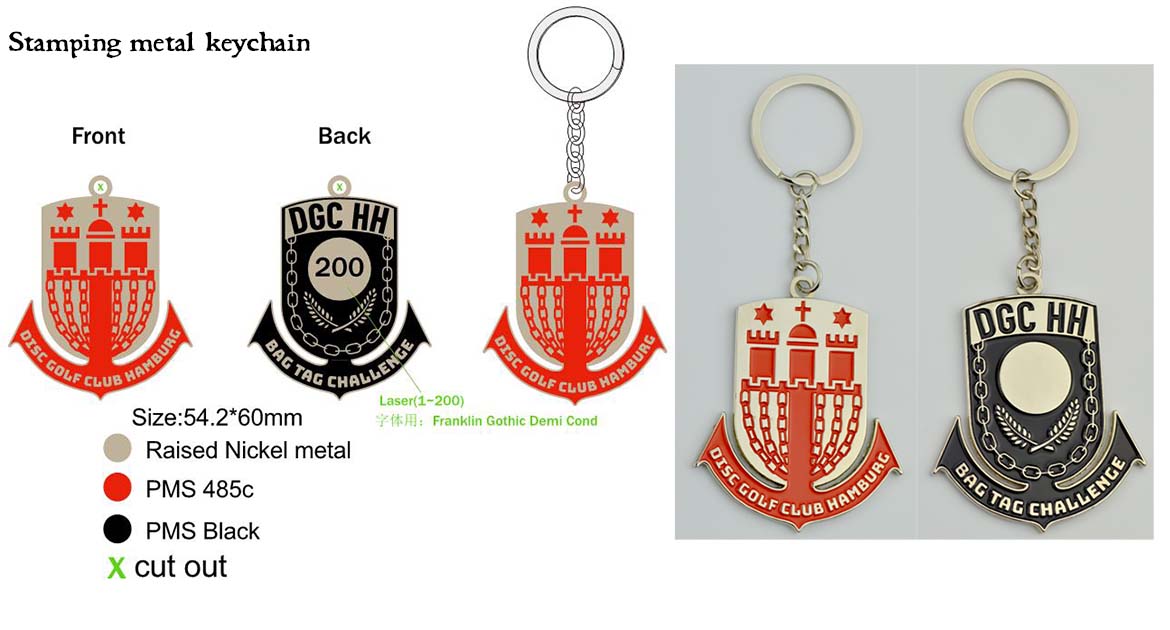
Audit Heavy Metal & Plating Compliance: For custom metal crafts (such as custom lapel pins, custom medals, and custom challenge coins), demand certified RoHS and REACH test reports ensuring electroplating processes use cyanide-free, lead-free, and nickel-release-compliant formulations.
Evaluate Durability as the Core Sustainability Metric: A poorly crafted item that breaks within weeks generates more net environmental waste than a durable, premium metal keepsake designed to be cherished for decades. As noted in research from the Incentive Research Foundation (IRF), high-quality commemorative items have an average retention rate exceeding 85%, preventing landfill disposal.
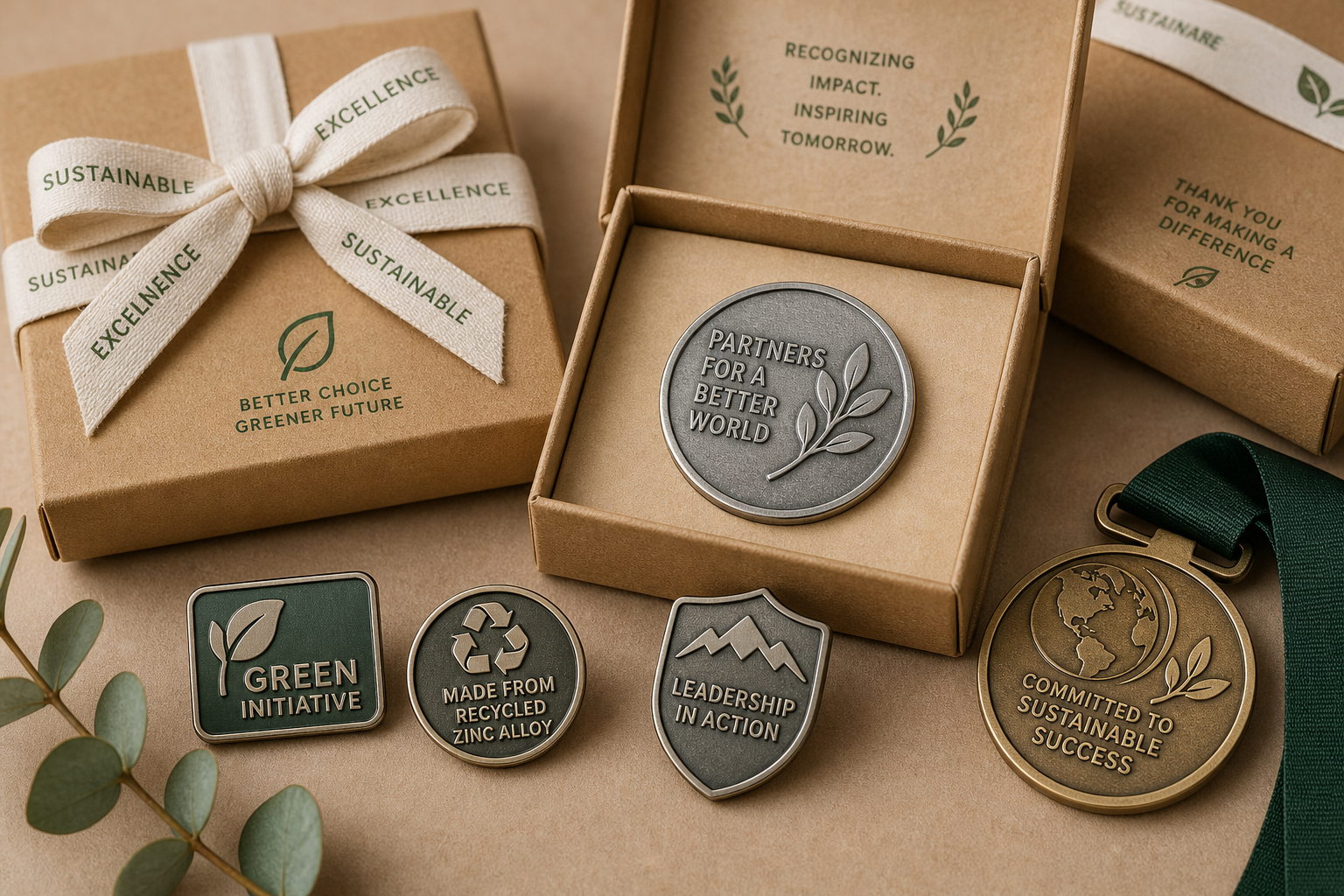
Insist on Eco-Conscious Packaging: Eliminate single-use plastic OPP bags where possible. Transition to FSC-certified unbleached kraft gift boxes, biodegradable cornstarch polybags, or reusable cotton drawstring pouches.
At Artigifts, we recognize that international B2B clients require transparent documentation alongside exceptional manufacturing quality. As an experienced manufacturer of custom lapel pins, medals, challenge coins, keychains, and corporate gifts, we integrate verifiable responsible manufacturing practices into our production lines:
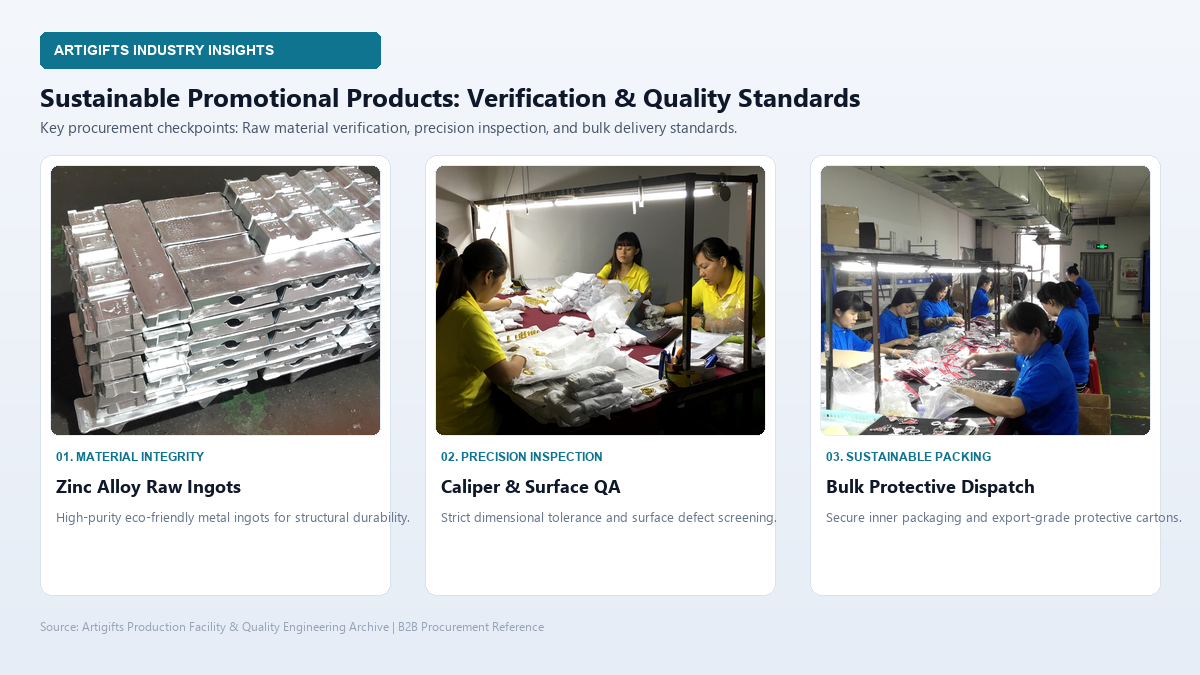
Material Integrity & Recycled Metal Options: We offer certified recycled zinc alloy and brass options, backed by batch spectrometry reports and chemical safety data sheets.
Eco-Compliant Electroplating & Enameling: Our surface finishing and coloring processes strictly adhere to RoHS 2.0, REACH SVHC, and California Proposition 65 standards, ensuring low-VOC, lead-safe, and nickel-safe finishes.
FSC-Certified & Minimalist Packaging Solutions: Clients can choose from bespoke FSC-certified kraft presentation boxes, recycled paper backer cards with soy-based ink printing, and plastic-free packaging workflows.
End-to-End Quality Assurance: Every batch undergoes comprehensive dimensional, adhesion, and plating thickness inspections before dispatch, ensuring gifts deliver lasting value rather than disposable clutter.
Learn more about our manufacturing capabilities, certifications, and compliance commitments on our About Us page.
Q1: What is the most reliable ecolabel for sustainable promotional products?
A: Type I multi-attribute third-party certifications (such as the EU Ecolabel or Cradle to Cradle) provide the highest reliability because they assess the entire product lifecycle. For specific materials, chain-of-custody standards like FSC (for paper/wood) and GRS (for recycled textiles/plastics) are the global gold standard.
Q2: Is it legal to label promotional gifts as “100% Eco-Friendly”?
A: No. Under both the US FTC Green Guides and the EU Green Claims Directive, broad, unqualified claims like “eco-friendly,” “green,” or “sustainable” are considered deceptive marketing unless every single aspect of the product’s extraction, production, transport, use, and disposal has zero environmental impact, which is practically impossible.
Q3: How do we verify that a supplier is using genuine recycled metal alloys?
A: Buyers should request a formal Material Test Report (MTR), spectrometry analysis from an accredited laboratory (e.g., SGS or Intertek), and a supplier declaration referencing ISO 14021 standards stating the exact percentage of pre-consumer or post-consumer recycled content.
Q4: Why is product durability considered a primary sustainability factor in corporate gifting?
A: Lifecycle analyses demonstrate that manufacturing energy and material extraction represent the largest share of a product’s carbon footprint. High-durability items like custom die-cast metal medals, coins, and badges are retained by recipients for years or decades, delivering superior environmental and brand ROI compared to disposable novelties that quickly enter waste streams.
Q5: What is the difference between RoHS and REACH compliance for custom promotional metal items?
A: RoHS specifically restricts ten hazardous substances (notably Lead, Cadmium, Mercury, and Hexavalent Chromium) up to strict percentage limits. REACH is a broader European chemical framework that restricts hundreds of Substances of Very High Concern (SVHC), including nickel release limits on items intended for direct skin contact and phthalate restrictions in coatings.
Q6: Can packaging be certified sustainable if the product inside is not?
A: Yes, but the marketing claim must clearly distinguish between the packaging and the product. For instance, labeling must state “Packaging made from 100% FSC-certified recycled paper” rather than implying the entire gift set is eco-certified.
Q7: How does Artigifts support clients in meeting corporate ESG gifting requirements?
A: Artigifts provides comprehensive product specification sheets, RoHS/REACH compliance documentation, material traceability for recycled alloy batches, and customizable FSC-certified kraft paper packaging options tailored to international corporate sustainability policies.
Promotional Products Association International (PPAI): Using Ecolabels To Find Sustainable Products & Responsibility Standards, https://www.ppai.org/media-hub/using-ecolabels-to-find-sustainable-products/
International Organization for Standardization (ISO): ISO 14020: Environmental labels and declarations — General principles, https://www.iso.org/standard/34426.html
Federal Trade Commission (FTC): Guides for the Use of Environmental Marketing Claims (16 CFR Part 260), https://www.ftc.gov/legal-library/browse/rules/guides-use-environmental-marketing-claims-green-guides
European Commission: Proposal for a Directive on Green Claims (Substantiation and communication of explicit environmental claims), https://environment.ec.europa.eu/topics/circular-economy/green-claims_en
Incentive Research Foundation (IRF): Merchandise and Incentive Gifting Retention & Sustainability Trends, https://theirf.org/