You can share
- Share to Facebook
- Share to Google+
- Subscribe to our
- Share to Linkedin
- Share to Twitter
You can share

Selecting the right base metal—whether zinc alloy, brass, pewter, or stainless steel—is the single most decisive factor determining the visual detail, weight, tactile perception, and long-term durability of custom promotional products and corporate recognition gifts. According to benchmark research from the Promotional Products Association International (PPAI) and the Incentive Research Foundation (IRF), over 66% of corporate buyers prioritize product durability and material authenticity over low unit costs, because high-quality tangible merchandise generates substantially higher recipient retention and brand recall.
For corporate marketing managers, procurement specialists, and event organizers, navigating metal specifications is often challenging. Each metal alloy behaves differently under high-pressure die casting, die striking, centrifugal spin casting, and electroplating. A material choice that works brilliantly for a lightweight 2D lapel pin may fail completely when applied to a high-relief 3D commemorative medal or a heavy-duty corporate keychain. This comprehensive technical guide analyzes the metallurgical characteristics, design constraints, decoration compatibility, compliance testing, and quality assurance checkpoints for the primary base metals used in custom metal gift manufacturing.
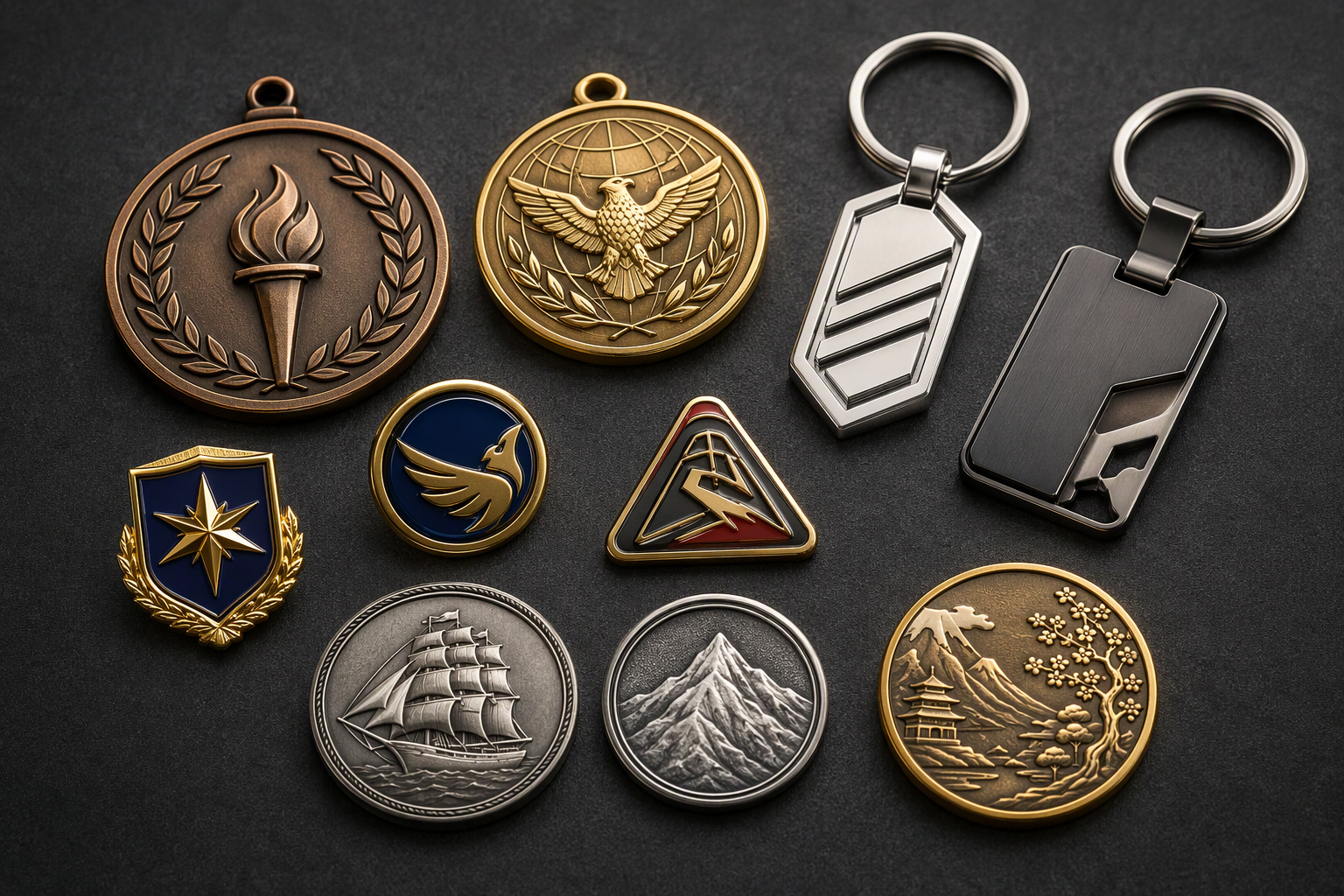
In promotional merchandise, physical weight and surface finish serve as subconscious proxies for corporate brand value. When an employee receives a recognition medal, or a VIP client accepts a commemorative challenge coin, the tactile density, edge sharpness, and mirror-like electroplating immediately convey the prestige of the sponsoring enterprise.
Choosing an inappropriate base metal introduces severe project risks:
Loss of 3D Detail & Crispness: Using stamped brass for multi-level sculpted artwork leads to softened relief and muted features because brass cannot flow into complex mold cavities like molten zinc alloy.
Premature Oxidation & Wear: Low-grade alloys with substandard electroplating or lack of protective lacquer develop tarnishing, pitting, and discoloration when exposed to skin oils and environmental humidity.
Regulatory Non-Compliance: Unverified metal sourcing can introduce hazardous heavy elements (such as lead, cadmium, or nickel release), risking severe import rejections under US CPSIA, California Proposition 65, and EU REACH / EN 71-3 regulations.
Budget & Freight Inefficiencies: Over-specifying heavy metals for high-volume mailing campaigns drives up international freight and postage without adding noticeable value to the recipient.
Understanding the metallurgical characteristics of the four primary metals enables procurement teams to match product design requirements with manufacturing capabilities:
Zinc alloy (predominantly Zamak-3 containing 96% zinc and 4% aluminum) is the undisputed standard for modern custom promotional metalwork. Its relatively low melting point (~385°C to 395°C) and superior fluidity under high hydraulic pressure allow molten alloy to fill micro-detailed mold cavities with micron-level precision.
Full 3D Sculpting & Deep Relief: Supports intricate architectural contours, human facial features, organic textures, and multi-layered stepped depths.
Complex Internal Cutouts: Cutout windows, filigree patterns, and skeletonized geometry are cast directly in the mold without requiring secondary punching dies.
Substantial Tactile Weight: With a density of approximately 6.7 g/cm³, zinc alloy delivers a satisfying, substantial weight in the hand.
Dimensional Stability: Highly resistant to warping, impact, and structural deformation over decades of storage.
Best Use Cases: Heavy custom award medals, dual-sided challenge coins with high relief, multi-functional promotional keychains, belt buckles, and 3D zinc alloy souvenirs.
Brass (an alloy of copper and zinc) has been the traditional benchmark for military insignia, premium lapel pins, and commemorative medallions for over a century. Unlike zinc alloy which is cast from liquid metal, brass items are formed through cold die striking under hydraulic presses exerting 50 to 300 tons of force.
Ultra-Sharp Geometric Precision: Die striking into solid brass yields the crispest 2D borders, sharpest lettering, and tightest metal lines in the industry.
Hard Enamel (Cloisonné) Compatibility: Brass can withstand high kiln baking temperatures (~800°C) required for true glass-paste cloisonné and imitation hard enamel.
Premium Density: At ~8.4 to 8.7 g/cm³, brass feels significantly heavier than zinc alloy of identical dimensions.
Best Use Cases: Premium corporate lapel pins, executive milestone coins, jewelry-grade cufflinks, and prestige anniversary emblems.
Pewter is a soft, malleable alloy consisting primarily of tin (85%–99%) combined with antimony and copper. It is cast using vulcanized silicone rubber molds mounted in high-speed centrifugal spin-casting machines.
Low Tooling Investment: Rubber molds cost roughly 60% less than steel die-cast tooling and can be prepared in hours rather than weeks, making pewter ideal for short-run prototypes and small batch orders (50–300 pieces).
Intricate Undercuts: Flexible rubber molds can be demolded around extreme undercuts, concave curves, and organic figurines that would jam in rigid steel molds.
Classic Antique Aesthetics: Pewter possesses a natural silvery-grey luster that accepts antique patinas, burnishing, and satin finishes exceptionally well.
Best Use Cases: Commemorative figurines, collectible holiday ornaments, vintage-style badges, and short-run artistic souvenirs.
Stainless steel (grades 304 and 316) is chosen for functional promotional tools and minimalist modern merchandise where mechanical strength and corrosion resistance are paramount.
Near-Indestructible Toughness: Exceptional hardness and resistance to bending, scratching, abrasion, and tensile stress.
Inherent Corrosion Resistance: Does not rely on electroplated coatings to prevent rust; ideal for outdoor, marine, and high-wear environments.
Precise Chemical Photo-Etching: Enables ultra-fine recessed lines, micro-perforations, and laser-engraved serial numbers.
Best Use Cases: Multi-tool keychains, promotional bottle openers, luggage tags, dog tags, and ultra-thin etched bookmarks.
The following matrix provides a clear engineering and procurement comparison to guide promotional product specifications:
| Evaluation Metric | Die-Cast Zinc Alloy | Die-Struck Solid Brass | Spin-Cast Pewter | Stamped Stainless Steel |
|---|---|---|---|---|
| Density (g/cm³) | ~6.7 g/cm³ | ~8.5 g/cm³ | ~7.3 g/cm³ | ~7.9 g/cm³ |
| Melting Point (°C) | ~385°C – 395°C | ~900°C – 940°C | ~230°C – 260°C | ~1400°C – 1450°C |
| Tooling Material | Hardened H13 Steel | Pre-Hardened Tool Steel | Vulcanized Silicone Rubber | Hardened Tool Steel Die |
| 3D Sculpting Capability | ★★★★★ (Exceptional) | ★★★☆☆ (Moderate 2.5D) | ★★★★★ (Exceptional) | ★☆☆☆☆ (Flat 2D only) |
| Cutout / Piercing Precision | ★★★★★ (Cast-in mold) | ★★★☆☆ (Needs punch die) | ★★★☆☆ (Moderate) | ★★★★☆ (Laser / Stamped) |
| Detail Sharpness (2D lines) | ★★★★☆ (Very High) | ★★★★★ (Ultra-Crisp) | ★★★☆☆ (Soft edges) | ★★★★☆ (Laser / Etch) |
| Hard Enamel Compatibility | ★★★★☆ (Synthetic resin) | ★★★★★ (True & Synthetic) | ★★☆☆☆ (Soft enamel only) | ★★★☆☆ (Epoxy / Printed) |
| Electroplating Range | Gold, Silver, Nickel, Antique, Black | Gold, Silver, Nickel, Bronze, Antique | Silver, Antique Pewter, Copper | Raw Polish, PVD Black, Gold |
| Tooling Cost Tier | Moderate ($150 – $350) | Moderate-High ($200 – $450) | Low ($60 – $150) | Moderate ($180 – $300) |
| Unit Production Cost Tier | Economical ($$) | Premium ($$$$) | Moderate-High ($$$) | Economical-Moderate ($$) |
| Recommended Minimum MOQ | 100 pcs | 100 pcs | 50 pcs | 200 pcs |
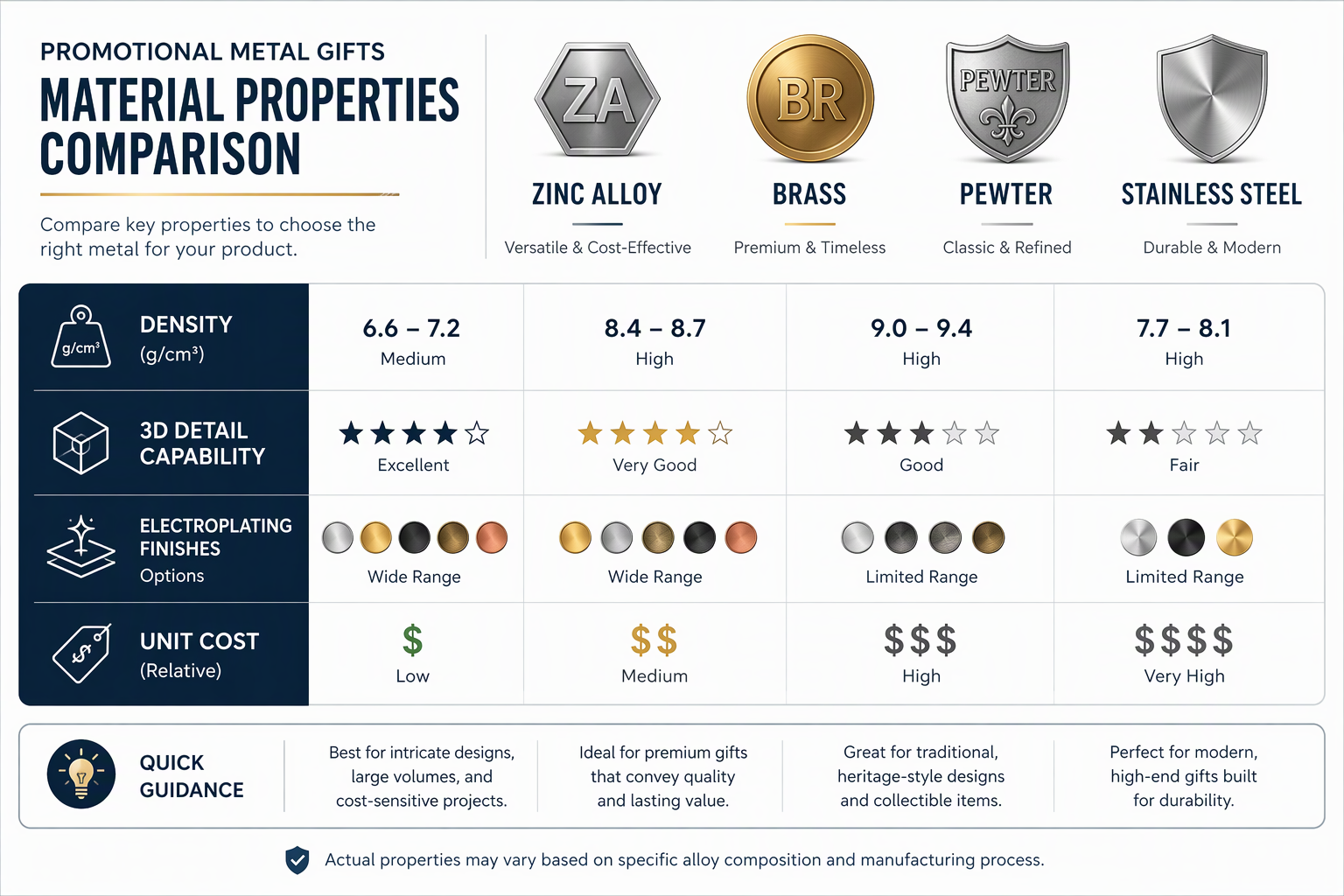
The base metal determines which electroplating baths, chemical patinas, and decorative color infills can be successfully bonded to the surface.
Quality metal gift manufacturing requires a multi-stage electroplating barrier rather than a single flash coating:
Ultrasonic Degreasing & Polishing: The raw cast or stamped metal undergoes vibratory deburring and hand-polishing to remove parting lines, micro-burrs, and surface porosity.
Copper Under-Plating (Strike Layer): For zinc alloy, a thick alkaline copper sub-layer is essential. Copper forms an impermeable metallurgical bond with zinc, preventing the base alloy from contaminating subsequent precious metal baths.
Nickel Diffusion Barrier: An intermediate nickel layer provides corrosion resistance, surface leveling, and enhanced brightness.
Precious Metal Topcoat: 24K real gold, 999 fine silver, rose gold, rhodium, black nickel, or antique bronze/brass is electrodeposited to achieve the target color and luster.
Clear Electrophoretic Lacquer: A microscopic baked polymer coating seals the plated metal, providing a 24- to 48-hour salt-spray barrier against sweat, atmospheric sulfur, and abrasion.
Soft Enamel: Liquid colored enamel is dispensed into recessed cavities below raised metal borders. After low-temperature baking, the enamel sits slightly recessed, creating a distinct tactile relief.
Imitation Hard Enamel (Polyhard): Heat-cured resin is filled flush with raised metal lines, then ground flat and polished together until the surface is completely smooth like porcelain.
UV Digital Printing with Clear Epoxy Dome: High-resolution CMYK gradients, corporate photographic portraits, or complex brand emblems are printed directly onto polished metal surfaces and protected with a crystal-clear polyurethane epoxy dome.
Procurement teams sourcing promotional products for multinational corporations, educational institutions, or public events must enforce strict chemical compliance. Ingestible or skin-contact metal items face rigorous regulatory scrutiny across major global jurisdictions:
| Regulation / Directive | Jurisdiction | Key Threshold Limits | Applicable Scope |
|---|---|---|---|
| US CPSIA / CPSC (16 CFR 1303) | United States | Total Lead (Pb) <= 90 ppm (coating); <= 100 ppm (substrate) | Children's items, pins, youth medals, school awards |
| California Proposition 65 | California, USA | Lead <= 100 ppm; Cadmium <= 300 ppm; Phthalates <= 1000 ppm | All promotional gifts, consumer merchandise |
| EU REACH (Annex XVII) | European Union | Nickel Release < 0.5 µg/cm²/week; Lead <= 500 ppm; Cadmium <= 100 ppm | Direct/prolonged skin contact (lapel pins, jewelry) |
| EN 71-3 (Toy Safety Standard) | EU & Global | Migration limits for 19 toxic heavy elements (Sb, As, Ba, Cd, Cr, Pb, Hg, etc.) | Event medals, youth badges, school awards |
| RoHS Directive (2011/65/EU) | EU / International | Restrictions on Pb, Hg, Cd, Cr(VI), PBB, PBDE | Functional electronic or USB metal gifts |
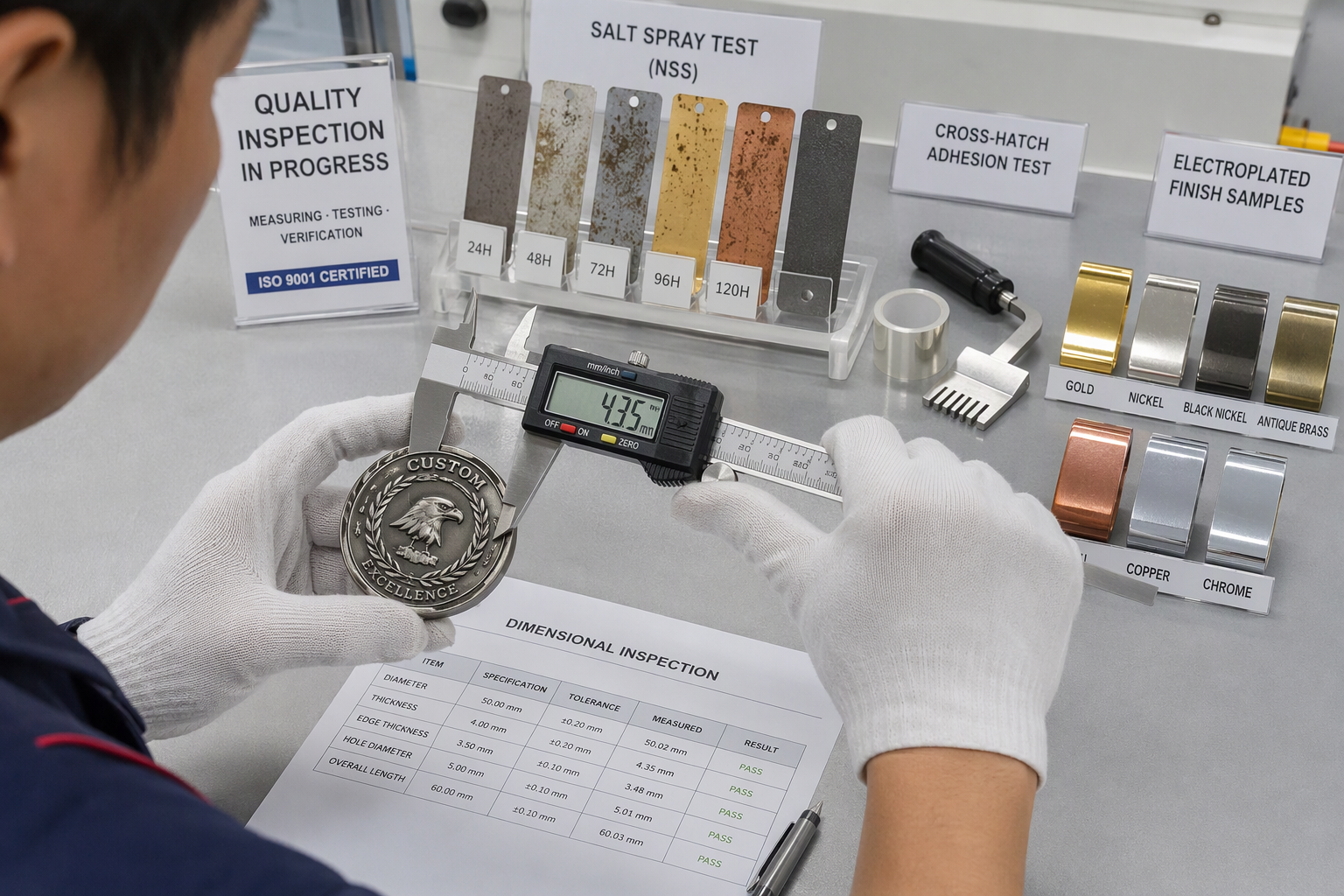
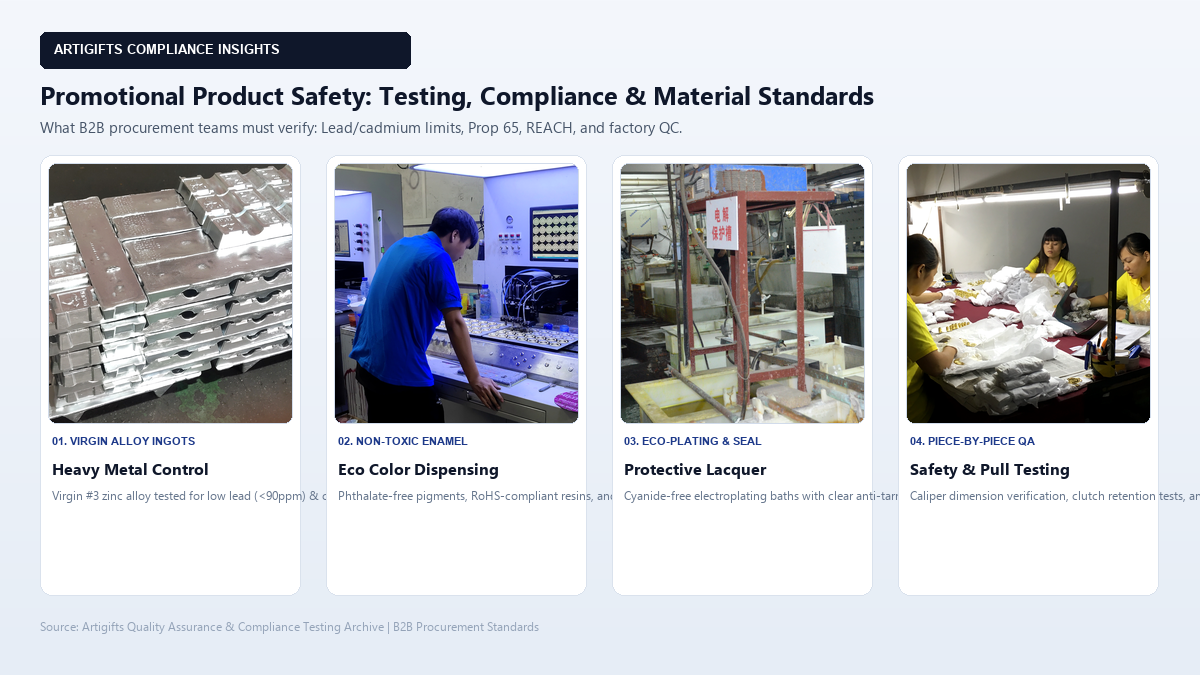
Experienced procurement managers utilize the following 6-point verification protocol when receiving digital proofs, pre-production samples, and mass-production batches:
1. Dimensional Tolerance & Gauge Measurement: Verify outer diameter, thickness, and cutout dimensions using digital vernier calipers against approved 3D engineering artwork (standard tolerance ±0.1 mm).
2. Weight & Density Verification: Check individual piece weight using high-precision electronic balances. Significant weight deviations (>5%) indicate internal porosity, hollow gas pockets, or improper alloy blending.
3. Cross-Hatch Plating Adhesion Test (ASTM D3359): On sample pieces, perform a cross-cut grid incision through the plating into the base metal, apply certified pressure-sensitive tape, and peel rapidly at 90°. Zero plating detachment indicates robust interlayer bonding.
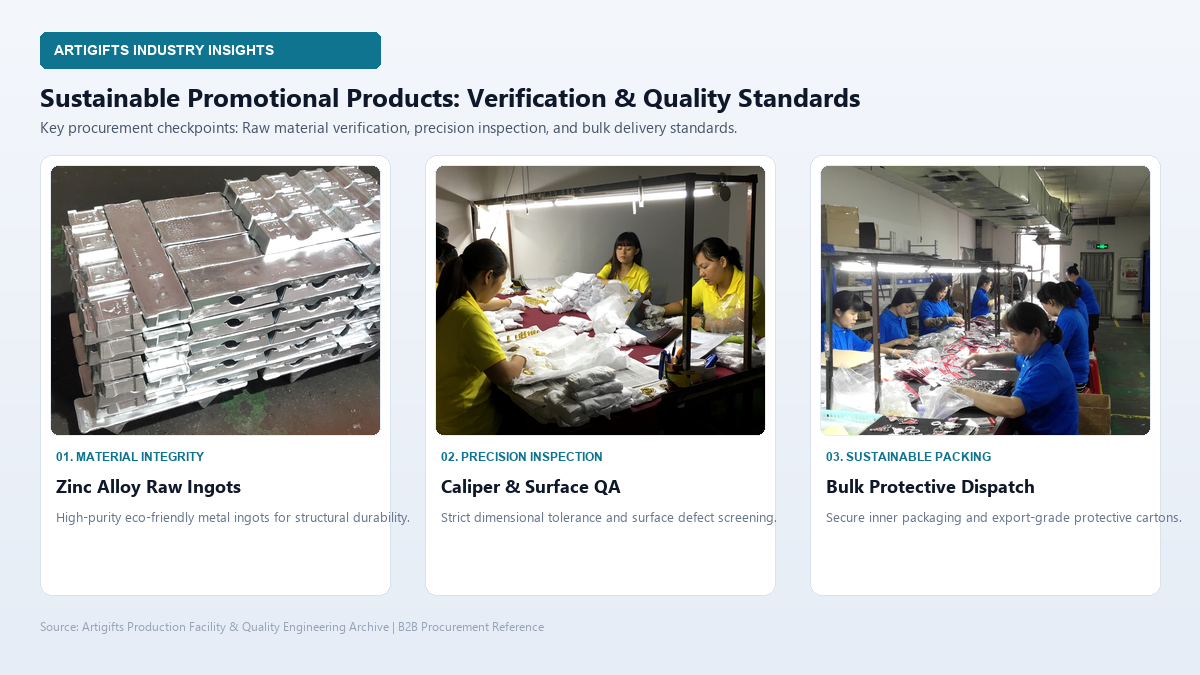
4. Neutral Salt Spray (NSS) Corrosion Testing (ASTM B117 / ISO 9227): Ensure metal samples withstand 24 to 48 hours of continuous 5% NaCl salt-fog exposure without exhibiting green copper oxidation, blistering, or white zinc rust.
5. Pantone PMS Color Matching & Curing Hardness: Inspect enamel infill under standard D65 daylight viewing booths against specified Pantone Formula Guides. Verify resin cured hardness using Shore D durometers or standard pencil hardness scratch tests (>= 2H).
6. Fastener & Attachment Mechanical Load Testing: For custom lapel pins, medals, and keychains, test the mechanical weld strength of butterfly clutches, safety pins, split rings, and ribbon jump loops under a minimum 3 kg to 5 kg tensile pull test.
When planning an annual promotional merchandise procurement budget, align each product category with its optimal material:
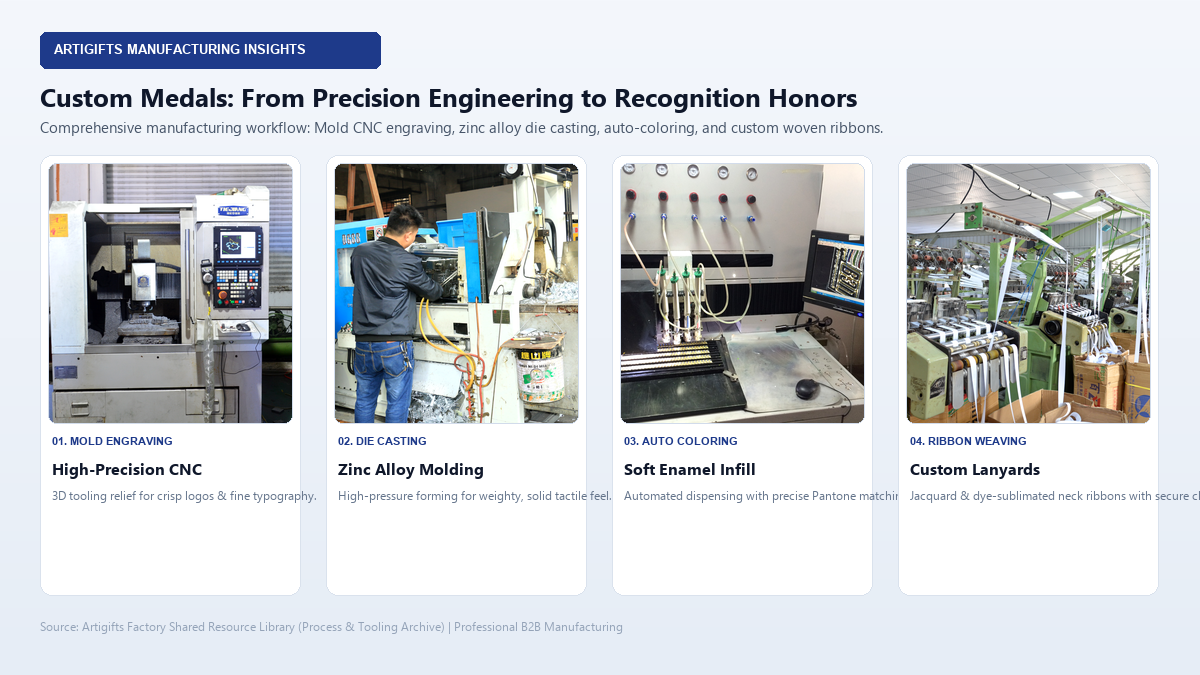
Sports & Marathon Custom Medals: Die-Cast Zinc Alloy is recommended because it allows large diameters (70 mm–100 mm) with full 3D sculptural reliefs, high-definition event lettering, intricate cutouts, and substantial weight while keeping unit costs and mold fees strictly controlled. Explore design options on the Artigifts Custom Medals page.
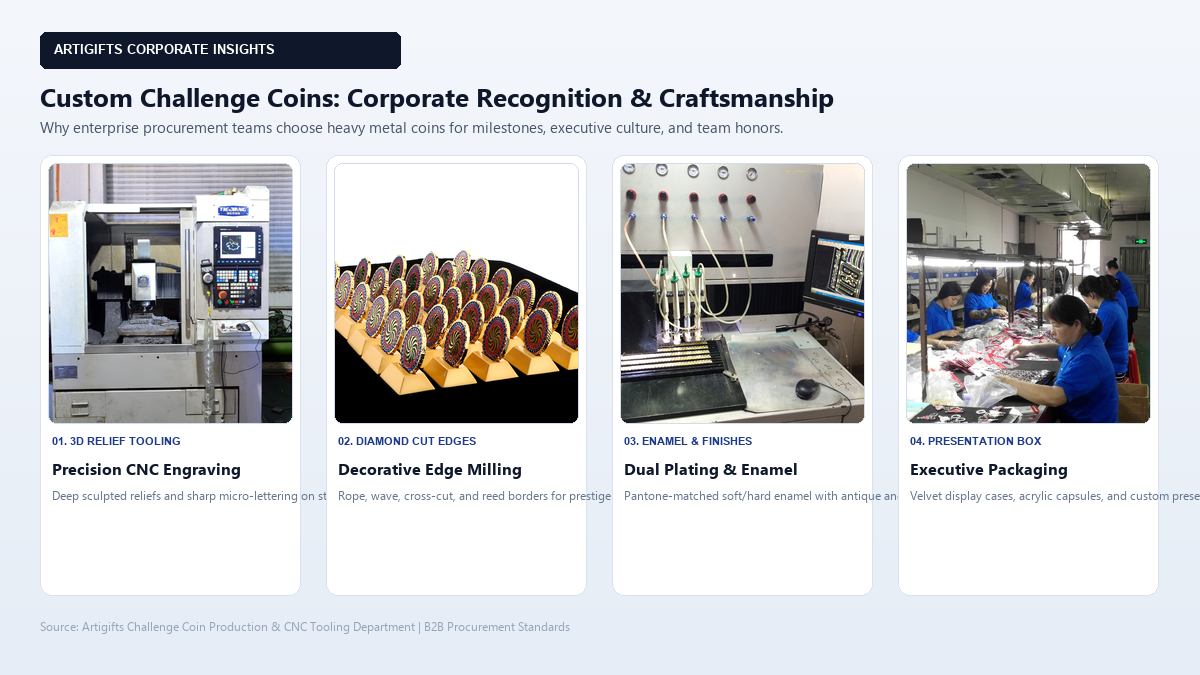
Corporate & Military Challenge Coins: Die-Cast Zinc Alloy (for complex 3D dual-side sculpts) or Die-Struck Solid Brass (for traditional flat-relief military collector pieces). Delivers clean reeded, diamond-cut, or rope edges combined with dual-tone plating. Review specifications on the Artigifts Custom Challenge Coins page.
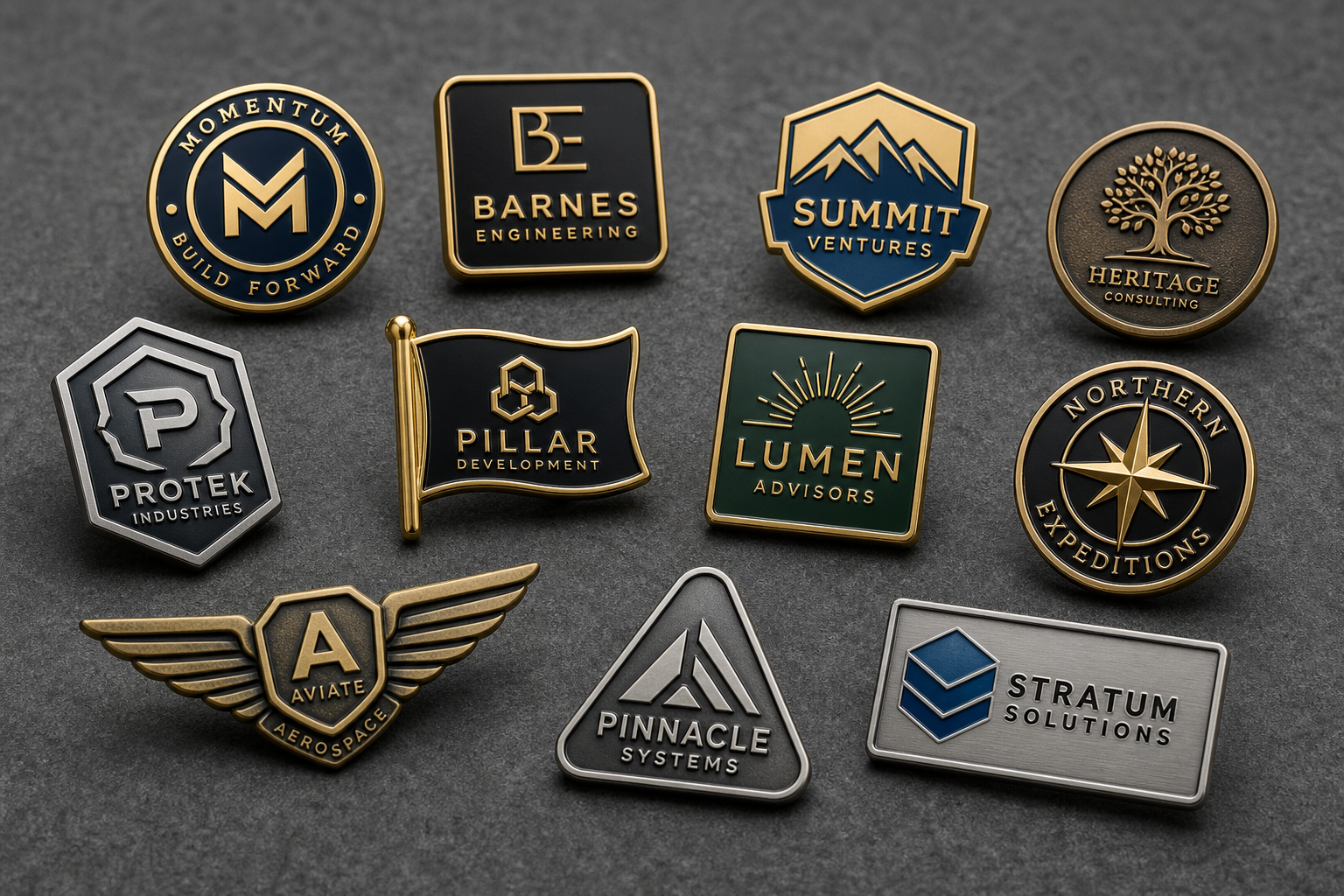
Employee Service Milestone & Association Lapel Pins: Stamped Solid Brass or Die-Cast Zinc Alloy. Brass accommodates imitation hard enamel with mirror-flat polishing for executive suits, while zinc alloy accommodates intricate miniature crests with delicate internal cutouts. Review mounting and enamel options on the Artigifts Custom Lapel Pins page.
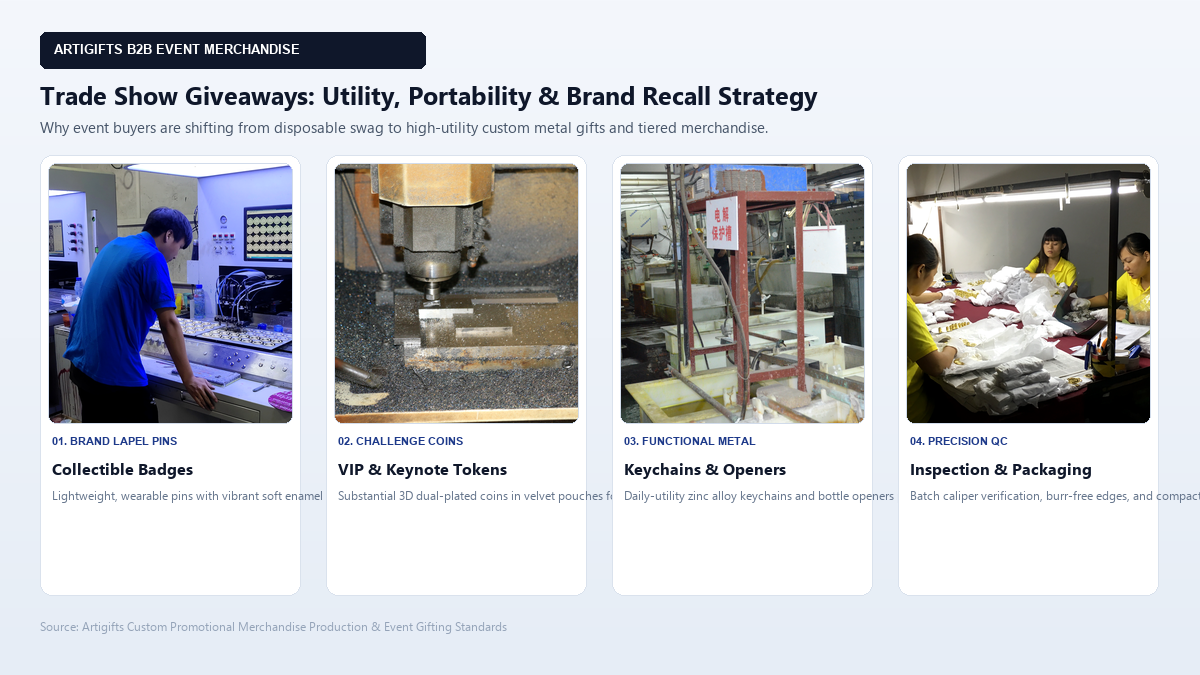
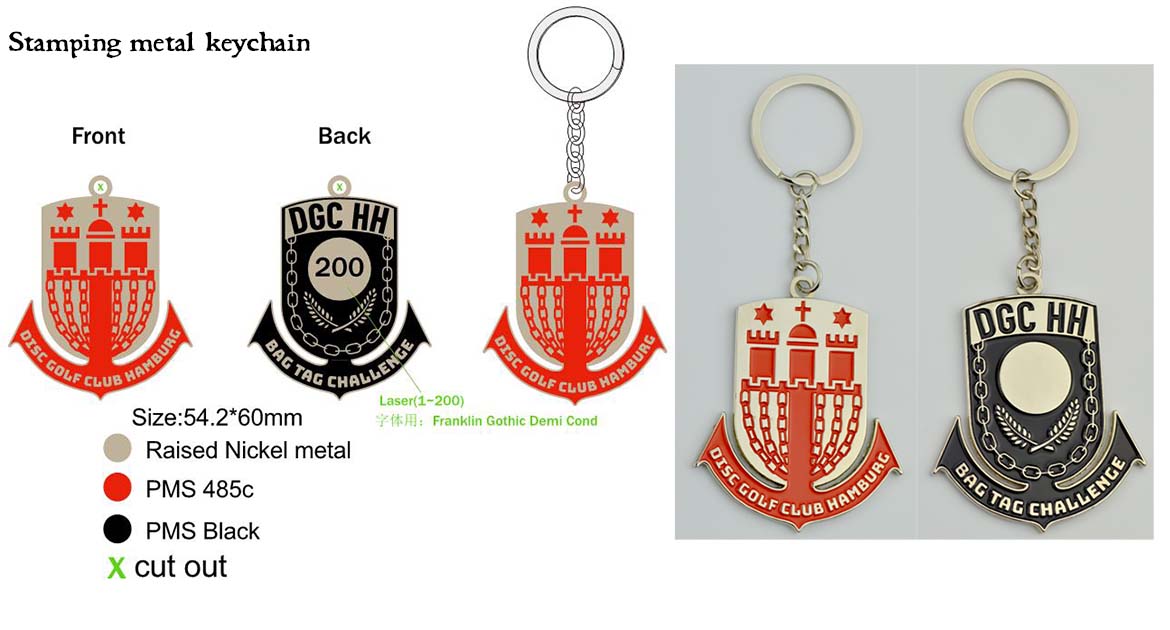
Executive Keychains & Branded Hardware: Die-Cast Zinc Alloy body paired with Stainless Steel split rings. Combines the complex 3D branding capability of zinc alloy with the spring-steel resilience and fatigue resistance of stainless steel key rings. Discover full factory capabilities on the About Artigifts manufacturing overview.
Q1: Why is zinc alloy generally preferred over brass for custom medals and challenge coins?
A: Zinc alloy is cast in a liquid state under high hydraulic pressure, allowing it to flow into complex, multi-level 3D mold cavities and intricate cutout areas that solid brass cannot replicate through mechanical die striking. Additionally, zinc alloy has lower raw material and tooling costs, making large-format awards (such as 3-inch to 4-inch medals) significantly more cost-effective for large event quantities.
Q2: Will zinc alloy promotional items rust or corrode over time?
A: Zinc alloy does not rust because it contains no iron. However, raw zinc can oxidize and form white surface patina if exposed to moisture and air without protection. High-quality manufacturers prevent this by applying a multi-layer electroplating barrier (copper strike layer + nickel barrier + top metal plating) sealed with a transparent electrophoretic protective lacquer, providing decades of tarnish resistance.
Q3: What is the main difference between soft enamel and imitation hard enamel on metal gifts?
A: In soft enamel, liquid color pigments are baked into recessed areas below the raised metal ridges, creating a distinct dimensional, textured surface. In imitation hard enamel (polyhard), color resin is filled flush with the metal ridges, baked at high temperatures, and then ground flat and diamond-polished until the entire surface is completely smooth like porcelain.
Q4: How do I know whether my custom pin or medal order complies with US California Proposition 65?
A: Compliance requires that total lead content is below 100 ppm and total cadmium is below 300 ppm in all accessible metal substrates and coatings. Buyers should specify California Prop 65 compliance in their purchase orders and request certified third-party laboratory test reports (such as SGS or Intertek XRF testing) from virgin ingot batches before final delivery.
Q5: Can pewter metal products be electroplated in bright gold and silver?
A: While pewter can be electroplated, its natural low melting point and softer metallurgical structure make it far better suited for antique patinas, antique silver, satin pewter, and dark oxidized finishes. For high-gloss mirror gold or polished chrome finishes, die-cast zinc alloy or stamped brass is strongly recommended.
Q6: How does product weight impact international air freight and distribution costs?
A: Metal merchandise is dense and heavy; a batch of 1,000 custom 3-inch medals can weigh over 80 kg to 100 kg. Zinc alloy (density 6.7 g/cm³) is roughly 20% lighter than solid brass (density 8.5 g/cm³), resulting in substantial air express freight savings for international shipments while maintaining an impressive, premium feel for recipients.
Q7: What is the typical lead time for custom die-cast zinc alloy vs. stamped brass production?
A: Both processes typically require 5 to 7 business days for precision CNC mold engraving and physical pre-production sample approval, followed by 12 to 18 business days for mass die-casting/striking, electroplating, color infill, quality inspection, and packaging. Expedited production can often be arranged for urgent event deadlines.
Selecting the appropriate base metal transforms custom promotional gifts from disposable novelties into cherished, long-lasting brand assets. By evaluating product dimensions, 3D relief complexity, electroplating requirements, international safety regulations, and overall program budget, procurement professionals can achieve the ideal balance of tactile prestige, visual fidelity, and cost efficiency.
When planning custom metal merchandise, partnering with an experienced direct manufacturer that operates in-house die casting, CNC mold engraving, multi-stage electroplating, and rigorous quality assurance guarantees that every medal, coin, pin, and keychain arrives on schedule and in full compliance with international standards.
PPAI Responsibility & Sustainability Hub: PPAI Product Safety and Compliance Guidance, https://www.ppai.org/media/responsibility/
PPAI Research (2026): Product Power: What Consumers Want Next, https://www.ppai.org/media-hub/product-power-2026-what-consumers-want-next-2/
Incentive Research Foundation (IRF): 2026 Trends Report: Tangible Rewards, Merchandise Sets, and Recognition Programs, https://theirf.org/research_post/irf-2026-trends-report/
ASTM International: ASTM F2923 Standard Specification for Consumer Product Safety, https://www.astm.org/
European Committee for Standardization (CEN): EN 71-3 Safety of Toys & Migration of Certain Elements, https://www.en-standard.eu/